
The Long Peace That Isn’t
A Geoeconomic Paradox That Threatens Middle Powers.

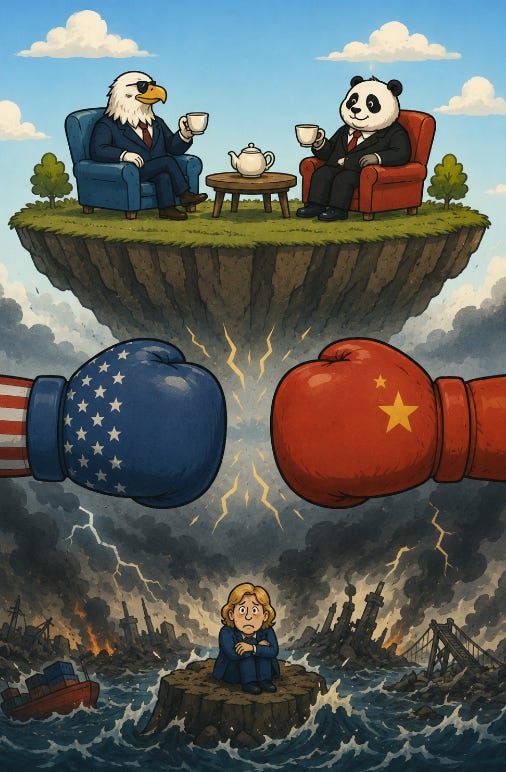
Inspired by an excellent Engelsberg piece by Katharina Klotz.
The Cold War had a peculiar logic. Two superpowers, each armed with enough nuclear warheads to reduce each other to rubble, spent four decades declining to use them. The scholar John Lewis Gadis famously called this the “long peace” – a period in which the existential threat of mutually assured destruction (MAD) kept the great powers from direct confrontation. If either side fired first, the retaliation would be apocalyptic. So neither did.
But the “long peace” was only peaceful if you happened to live in Washington or Moscow. Below the threshold of nuclear annihilation, the two superpowers waged persistent sub-threshold conflict through proxies – in Korea, Vietnam, and Afghanistan. Strategic stability at the top of the escalation ladder did not suppress conflict but relocated it downwards, onto small states who had little say in the matter.
This is the stability-instability paradox, first coined by the political scientist Glen Snyder in 1965: the very condition that prevents great powers from destroying each other creates a permissive environment in which they feel free to fight conventional war, at lower levels, indefinitely.
The same paradox is now reasserting itself in the 21st century, but in the realm of economics rather than traditional warfare. Weapons have been replaced by export controls, critical minerals, and technological chokepoints. Just as small countries in the Cold War found themselves becoming proxies for great power conflict, so middle powers – most especially Europe – will find itself caught in the crossfire with few of its own tools of economic deterrence.
This stems from the fact that Washington and Beijing are locked into the geoeconomic equivalent of mutually assured destruction. Neither can fully, or immediately, decouple without wrecking their own economies and economic security. China demonstrated its strength recently. Beijing accounts for around 60 per cent of global critical minerals mining and 92 per cent of global processing. When Washington ratcheted up tariffs in 2025, Beijing deployed this dominance ruthlessly. And China holds other cards, such as holding a large volume of U.S. Treasury bonds – which could hypothetically be sold off and rapidly drive up U.S. interest rates (though admittedly this would also be an act of self-harm from China’s perspective).
Washington has an equivalently fearsome hand in return: control of the SWIFT payments architecture from which it has already excised Iran and Russia, and from which China, despite its efforts to build alternatives, still cannot escape. China’s own cross-border payments system relies on SWIFT’s messaging infrastructure for over 80% of its transactions.
Both sides, then, hold weapons of economic or financial mass destruction. But there is a tacit understanding that neither would fully use them, because the retaliation spiral would be too destructive. However, this mutual restraint does not produce peace. It instead produces a permanent environment for sub-threshold geoeconomic aggression. The United States ratchets semiconductor export controls chip by chip; China responds mineral by mineral. Each move inflicts pain but no one realistically thinks it would reach catastrophe. After all, Trump does always chicken out.
Yet like the Cold War before it, the costs of this “long peace that is no peace” fall hardest on middle powers with little leverage – Europe being a case in point. One example is ASML, the Dutch company that produces the lithography machines on which global chip manufacturing depends. Since 2019, Washington has pressured the Dutch government to restrict ASML’s exports of advanced chip-making equipment to China — a bilateral squeeze conducted between two great powers, using a European company as the instrument. ASML’s own CEO has publicly complained that restrictions originally framed as national security measures have become increasingly economically motivated. With very few of its own levers to hand, and with little work being done to develop its own “chokepoints”, there is a danger that Europe continues to get caught in the geoeconomic crossfire.
And the squeeze extends beyond Europe. Back in 2025 Malaysia pulled out of a China-backed AI project involving Huawei infrastructure, having come under pressure from the U.S. during trade talks. The Cold War II geoeconomic and technological battlefield is therefore being played out across the world’s middle powers. Where an “iron curtain” fell across the globe in the twentieth-century -- pulling smaller powers into its ripples -- a similar thing is happening here. Except political-economic blocs are being replaced by techno-economic ones, with countries gradually feeling pressured to opt for either U.S. or Chinese digital infrastructure; and the ability to hedge between them will likely become more difficult.
The lesson of the first Cold War was not that mutually assured destruction made the world safe. The “long peace” existed for the great powers, but made the world permanently unstable for everyone else. Stability at the top; chaos at the middle and lower rungs. In Cold War II, the geoeconomic long peace will follow the same logic, and unless Europe gets a move on it may have to accept being a bystander.