
The Limits of Leverage
Why Building European Economic “Chokepoints” Might Not Work.

See short, ‘Letter to the Editor’ version in the Financial Times.
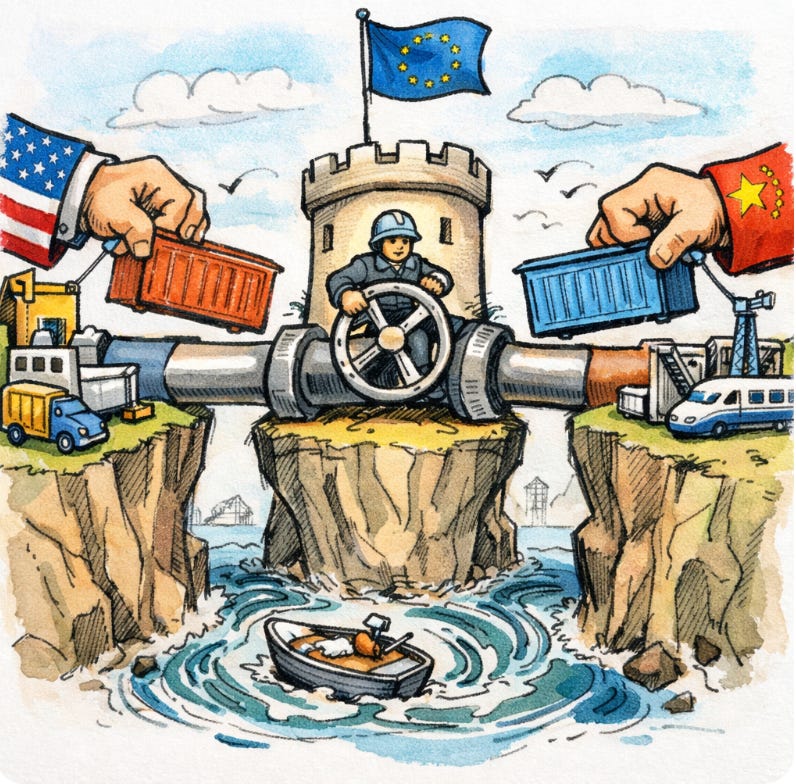
The rhetoric in Europe, and within UK policy circles, is becoming a bit more hawkish – from Mark Carney’s revered Davos speech to new calls for Europe to build and weaponise its own chokepoints. And policy work is increasingly being done in this area.
I have a lot of sympathy for this, and have made similar arguments before that Europe and the UK need to not only build resilience but have their own leverage within global supply chains to have a seat at the big boy table.
However, it’s also important to consider the challenges of this more aggressive approach. Not to say that it shouldn’t happen, but that it’s not quite as simple as it sounds: the gap between building leverage and actually using it effectively is large and needs serious thinking.
If we take the Netherlands and ASML as an example, probably the pre-eminent case of a European “chokepoint” in high end photolithography, there are five challenges I see in translating this into diplomatic power.
First, pulling the trigger might erode it. ASML only sells about forty Ultraviolet Photolithography machines a year to a small handful of markets – the United States, Taiwan, China, and Japan. Further, its technological edge (or “moat”) is heavily sustained by data feedback loops with continual collaboration with leading customers. Cutting off even one of these markets, or threatening to, would erode ASML’s low output, high yield, selective market business model. You might say, well ASML is so far ahead that it can get away with this. Sure – but it’s balance sheets still need to add up.
Second, no “chokepoint” exists in a silo. The extent of interdependence narrows the choice of countries like the Netherlands, even if they have a killer card. In fact, having ASML has arguably led to the Dutch being more pushed around, not less. Most ASML-related export control decisions have come from American pressure to lock China out of the semiconductor race – not the result of grand Dutch strategy. Similarly, the spat between the Netherlands and China over Nexperia is proof that having useful companies can mean getting pushed around more, not less. Ultimately, the Netherlands may have asymmetric leverage over a country like the U.S. in one arena – but when one considers everything to financial infrastructure, cloud, and the U.S. military umbrella, the Netherlands is outgunned.
Third, cutting off adversaries can lead to faster substitution, as has been seen most obviously with U.S. chip export controls on China – or faster innovation, as in the case of the “DeepSeek moment”. China is also now investing heavily in developing its own advanced EUVs. Once again, this boils down to the conundrum that – like a bee sting – you can use it, but then you lose it. That in turn makes “economic deterrence” via chokepoints less credible – dampening attempts not only to use chokepoints, but even to threaten to use them.
Fourth, how does the state put pressure on its own private companies? It’s not infeasible, and economic security regulation – from anti-foreign subsidies rules to harder hitting foreign direct investment screening – is gaining more teeth in Europe and the UK. However, there is not yet a real playbook for how Western capitalist societies can coax their “national winners” into a game of economic security chess. Arguably, China and even the United States have a longer tradition of the national-security state working alongside private sector titans.
Fifth, squeezing chokepoints could reduce long-term competitiveness. Even if domestic champions can be forced to play the game, this may well have a deterrent effect on future founders and firms being set up in that country – ultimately eroding competitiveness and, eventually, economic security.
None of these problems are insurmountable but they add up to an important point. Just because the global political economy operates in such a way that these “structural chokepoints” exist, does not make necessarily make them usable – especially for middle powers who at best might have one or two cards to play. More work needs to be done to help the UK and Europe not just find and build their chokepoints, but actually understand how to use them.
Put simply: hypothetical “leverage” does not always spell real power.